The 48-Team Equation: How the 2026 World Cup Format Rewrites the Tactical Playbook

For decades, the tactical rhythm of a FIFA World Cup was entirely predictable. The classic 32-team structure allowed managers to treat the group stage as a calculated, three-act chess match. You could hunt for a win in game one, steady the ship with a pragmatic draw in game two, and rotate your squad or play for goal difference in game three.
But as the tournament arrives in Canada, Mexico, and the United States, that familiar manual has been completely thrown out the window.
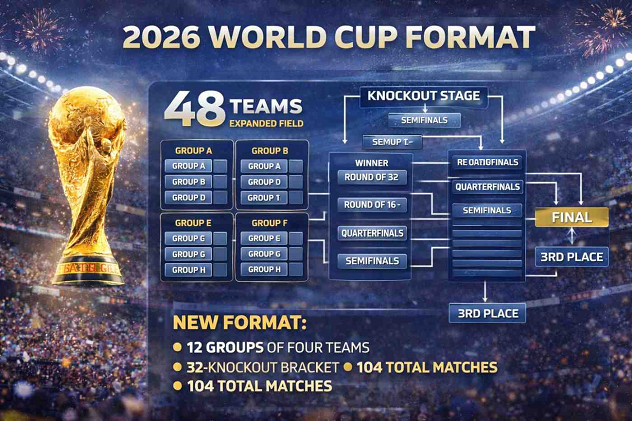
The expansion to 48 teams grouped into twelve blocks of four doesn’t just mean more football—it fundamentally alters how a national team must approach a tournament structurally, physically, and tactically. With the introduction of a massive Round of 32 knockout stage, the margin for error has evaporated. As an analyst looking at the physical demands of modern football, I believe the teams that lift the trophy won’t necessarily be the ones with the flashiest starting XIs, but the ones whose managers best master the new mathematics of squad rotation and game management. Even when evaluating the tournament’s unpredictable nature from an analytical perspective, looking at how data models from the top non-GamStop sportsbooks tested structure their tournament projections reveals just how wide open this expanded format makes the field.
The Death of the “Dead Rubber” and the Rise of High-Intensity Openers
Under the old system, elite footballing nations often used their third group match to rest key assets, flush out yellow cards, and protect their tactical secrets for the knockout phase.
The 2026 format introduces a fierce variable: the eight best third-place teams will now advance to the knockout rounds. While this offers a safety net for slow starters, it simultaneously turns the entire group phase into a relentless sprint for goal separation.
[4-Team Group Stage] ➡️ [Top Two + 8 Best 3rd-Place Teams Advance] ➡️ [New Round of 32 Knockout]
Because goal difference and goals scored against a broader pool of third-place competitors will decide who survives, top-tier teams can no longer afford to take their foot off the gas after going 2-0 up against lower-ranked opposition. We are going to see a drastic shift in tactical setups:
- Aggressive Transition Play: Instead of slowing down match tempos to conserve energy, dominant teams will likely employ high-pressing, vertical attacking systems for the full 90 minutes to maximize their goal tallies.
- The Exposure of Low-Block Defenses: Underdog nations who traditionally relied on an ultra-conservative, 5-4-1 low-block to grind out a 0-0 draw will find that a single point is rarely enough to guarantee a spot in the top twenty-four. They will be forced to transition into riskier counter-attacking shapes.
The 87-Day Micro-Cycle: Physical Conditioning and Depth
To truly understand how brutal this tournament will be on player bio-energetics, consider the sheer volume of games. The finalists will now have to navigate eight matches instead of the traditional seven, crammed into a summer heatwave across three massive host countries.
The Midsummer Test
I wanted to evaluate what this looks like from a sports science perspective. Imagine a high-pressing side operating in a dynamic 4-3-3 system. Under normal club conditions, a central midfielder might cover 11.5 kilometers per match, with roughly 800 meters spent in high-intensity sprinting zones.
If that player is forced to repeat that output across four matches in a two-week span—frequently traveling between drastically different time zones and microclimates—their performance drops exponentially. Tracking metrics from recent international tournaments shows that passing accuracy under pressure degrades by up to 8% when a player enters the “red zone” of cumulative fatigue.
The conclusion? Managers who refuse to embrace deep, early squad rotation will see their tactical systems collapse under the weight of soft-tissue injuries by the time they hit the quarter-finals. For a deeper look at how elite squads manage these physical and spatial metrics, dive into our archive of advanced tactical analysis tracking the game’s evolving patterns.
Formations for the Expanded Era: Flex-Shapes vs. Rigid Systems
Because teams will face an incredibly diverse array of playing styles due to the increased global representation, tactical flexibility will trump rigid philosophy. The managers who succeed will likely favor “chameleon” systems—formations that can seamlessly morph without requiring personnel changes.
| Tactical System | Defensive Shape | Attacking Phase | Primary Risk Factor |
| The Fluid 3-4-2-1 | 5-4-1 Low Block | 3-2-5 Overload | Extreme physical toll on wing-backs |
| The Hybrid 4-3-3 | 4-5-1 Mid-Block | 2-3-5 Inverted | Vulnerability to rapid central transitions |
| The Direct 4-4-2 Diamond | 4-4-2 Narrow | 4-1-2-3 Attacking | Lack of natural width against overlapping fullbacks |
We are moving away from the era where a nation could simply impose its singular identity on every opponent. The group stage will demand rapid adaptations, shifting from breaking down a stubborn defensive wall on a Monday to neutralising an unpredictable, chaotic transition engine on a Friday.
Navigating the Extended Knockout Bracket
The true tactical test begins at the Round of 32. Adding an extra single-elimination game introduces a chaotic multiplier to the tournament. In knockout football, tactical pragmatism usually reigns supreme; as the stakes rise, spaces contract.
Step 1: Managing the Yellow Card Traps
With an extra match added to the schedule, managing squad discipline becomes paramount. An accidental booking in the new Round of 32 could completely dismantle a team’s defensive spine ahead of a heavyweight Round of 16 clash.
Step 2: The Specialization of Extra-Time Substitutes
With games going the distance, the “finisher” role becomes a distinct tactical weapon. Savvy managers will deliberately hold back specialized press-breakers or isolated penalty-saving specialists, using their five available substitutions not just to replace tired legs, but to fundamentally alter the structural layout of the pitch in the 75th minute.
The Verdict: The expansion of the tournament changes the fundamental nature of international management. It is no longer just about picking the best players; it is about engineering a multi-layered, highly adaptable squad capable of surviving a grueling, eight-game gauntlet. The tactical masterminds who lift the trophy will be those who view the new layout not as an administrative burden, but as an entirely new canvas for strategic innovation.
Total Football Analysis is dedicated to breaking down the structural, statistical, and human elements shaping the beautiful game. Keep your eyes on our main feeds for ongoing tactical breakdowns as the road to the final unfolds.