A flat commercial roof is not the liability most owners think it is. The gamble everyone fears, standing water and slow leaks, is almost always a workmanship problem, not something baked into flat roofing itself. So when the owner of a 6,000 square foot retail-and-office building in a first-ring Minneapolis suburb starts pricing a replacement, the first call should go to seasoned commercial roofers minneapolis mn who can show exactly how they finish a seam. Skip that step and the myth becomes self-fulfilling. Water always finds the weak seam.
The Ponding Myth That Scares Building Owners
Ponding gets blamed for everything. A little standing water after a heavy storm is not the disaster it looks like, because a properly specified TPO system is built to sit wet for a stretch without wicking moisture down into the building. Trouble starts when that water pools over a bad seam or a drain that was never set at the true low point, and that is a construction defect, not a flat-roof inevitability. Verisk’s 2026 roof report found that roofs in moderate-to-poor condition carry roughly 60% higher loss costs, and that 16 states saw severe hail strike at least a fifth of their roofs last year, up from 12 the year before. Read that carefully. Condition drives cost far more than the shape of the roof does.
The pattern we see most often is simple. The field of the membrane, the big open middle, is usually fine years later. The failures cluster at the edges, the drains, and the rooftop penetrations where a rushed crew cut a corner. That is good news for an owner, because details are controllable in a way the weather never will be.
- How do you weld and test the seams? A straight answer names hot-air welding and an actual probe or air test, not just a visual once-over.
- What is your plan for the low spots where water ponds? A good answer talks tapered insulation to build slope, not another coat of coating.
- How do you flash the penetrations and the perimeter? Listen for specifics on curbs, drains, and terminations, since that is where most leaks begin.
- What covers the membrane versus the labor? A solid answer separates the manufacturer material warranty from the workmanship warranty and states the years on each.
What A Welded TPO Membrane Actually Handles
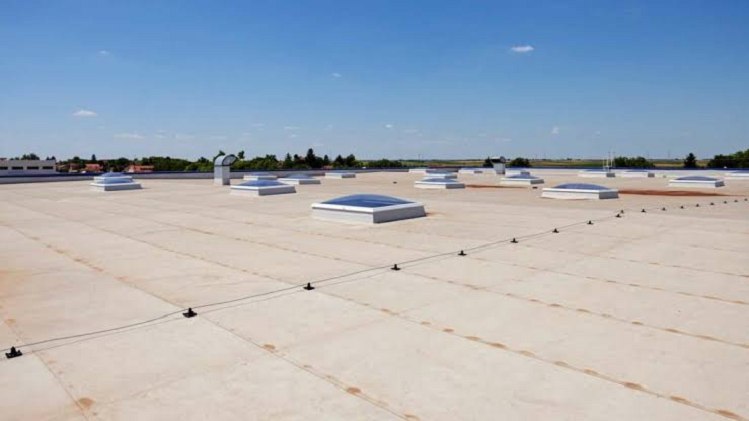
The membrane design does most of the real work. The seams on a TPO roof are hot-air welded, meaning a machine or hand tool melts the two sheets together into one continuous surface instead of gluing or taping them. A correct weld is actually stronger than the membrane on either side of it, so a roof welded right behaves like a single sheet stretched tight across the whole building. That is the opposite of the leaky patchwork people picture when they hear the words flat roof.
The membrane does more than shed water. TPO is bright white and reflective, so it bounces a large share of summer heat back off instead of soaking it into the building the way old black roofs did, and that shows up on the cooling bill. Under that white sheet sits rigid insulation, often tapered on purpose to build gentle slope toward the drains and erase the low spots ponding loves. Every layer has a job, which is why the good crews talk about the roof as a system rather than a sheet.
Minnesota winters are the real stress test, not the July rain. Freeze-thaw cycling punishes anything that absorbs water and then expands as it freezes. A freeze-thaw study in the Journal of Infrastructure Preservation and Resilience measured this on wood rather than roofing, and after 60 cycles untreated red oak had lost about 12.7% of its stiffness while thermally modified oak gained close to 10%. The lesson carries over cleanly: materials engineered for the cycle survive it, and materials that merely tolerate it slowly give up. I could rant for a page about the peel-and-stick patches I have watched fail in this climate, but back to the membrane.
The bigger threat now is hail, not slow wear. In April 2026, Claims Journal reported that Allianz tied severe convective storms, driven mostly by hail, to about $60 billion in US insured losses for 2025, nearly half of all catastrophe losses. A single-ply membrane will not stop a hailstone. But a welded, well-flashed roof responds as one connected system and keeps a surface bruise from becoming an interior leak, which is the whole gap between a quick repair and a torn-open ceiling.
Choosing An Installer Who Proves The Seams
So the choice was never really flat versus pitched. It was who installs the roof and whether they will prove the seams before they hand over an invoice. Ask to watch a probe test, ask how they build slope into the low spots, and ask what the workmanship warranty actually covers, because those answers separate the crews worth hiring from the ones who leave you the horror story. For a 6,000 square foot building staring down another round of hard freezes, the right commercial roofers minneapolis mn treat the seams and flashings as the main event, not an afterthought at the end. A welded TPO roof, installed by people who obsess over those details, is one of the most predictable systems you can put over a commercial building. Predictable is what an owner actually wants.