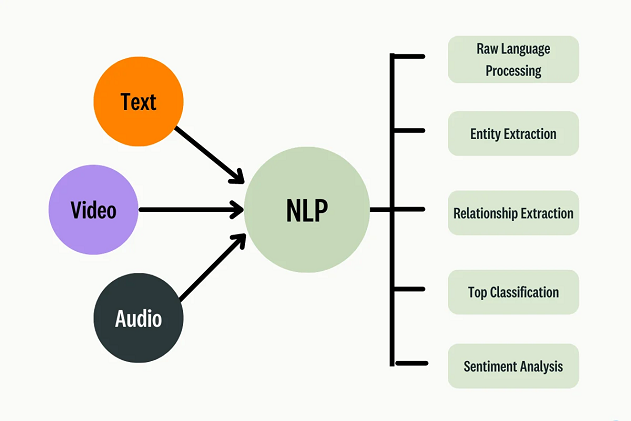
Natural language has become one of the most valuable sources of business information. Every day, organizations generate enormous volumes of emails, support tickets, meeting transcripts, contracts, reports, customer reviews, and internal documentation. Most of this information exists as unstructured text, making it difficult to analyze using traditional software systems.
This challenge has accelerated the adoption of Natural Language Processing (NLP), particularly solutions powered by deep learning. Modern deep learning models can understand context, identify intent, summarize large documents, classify information, and even generate human-like responses. As enterprises continue to digitize operations, NLP is evolving from a specialized capability into a core business function.
The real challenge, however, is not building a prototype. It is deploying and maintaining NLP systems across millions of interactions, multiple departments, languages, and compliance requirements. That is where enterprise-scale deep learning becomes essential.
What Is Deep Learning for Natural Language Processing?
Deep learning is a branch of machine learning that uses neural networks with multiple layers to learn patterns from data. In NLP, deep learning enables computers to understand language in ways that were difficult or impossible with rule-based systems.
Earlier NLP solutions relied heavily on manually crafted rules and dictionaries. While effective for simple tasks, they struggled with ambiguity, context, and language variations. Modern transformer-based architectures changed this dramatically by allowing models to understand relationships between words and phrases across entire documents rather than analyzing them individually.
Today, deep learning powers applications such as:
- Intelligent document processing
- Sentiment analysis
- Customer support automation
- Contract review
- Knowledge management systems
- Content moderation
- Language translation
- Enterprise search
- Conversational AI assistants
Organizations seeking to implement these capabilities often work with deep learning developers at Tensorway to build solutions tailored to industry-specific requirements and operational constraints.
Why Are Enterprises Investing Heavily in NLP?
The amount of textual data produced by organizations continues to grow faster than human teams can process it. Valuable information is often buried inside thousands of documents, conversations, and records.
Modern NLP systems help organizations:
- Reduce manual processing workloads
- Improve customer service response times
- Accelerate knowledge discovery
- Extract insights from large datasets
- Improve decision-making
- Automate repetitive communication tasks
Businesses are increasingly using NLP to transform unstructured information into actionable intelligence. This shift allows teams to focus on higher-value activities instead of spending hours searching through documents or manually categorizing data.
How Do Transformer Models Enable Enterprise-Scale NLP?
The rise of transformer architectures fundamentally changed what NLP systems could achieve.
Unlike earlier approaches that processed text sequentially, transformers use self-attention mechanisms to understand relationships between words regardless of their position in a sentence. This allows models to capture long-range context and produce significantly more accurate results across a wide range of language tasks.
Well-known transformer-based models include:
- BERT
- GPT-based architectures
- T5
- RoBERTa
- DistilBERT
These models can be pre-trained on massive datasets and then fine-tuned for specific enterprise applications. This approach dramatically reduces development time while improving performance across tasks such as classification, summarization, question answering, and information extraction.
What Challenges Appear When NLP Systems Scale?
Building a successful pilot is only the beginning. Enterprise deployment introduces challenges that many organizations underestimate.
Data Quality and Consistency
Large enterprises often store information across multiple systems, formats, and departments. Documents may contain inconsistent terminology, missing information, or outdated language.
Without strong data governance, even the most advanced model can produce unreliable results.
Infrastructure Requirements
Modern NLP models require substantial computing resources for training and inference. Organizations must balance performance, latency, and operating costs.
As usage grows, infrastructure must support:
- High request volumes
- Real-time processing
- Security controls
- Model monitoring
- Automated retraining
Compliance and Privacy
Industries such as healthcare, finance, and legal services operate under strict regulatory requirements.
Organizations must ensure that NLP systems:
- Protect sensitive information
- Maintain audit trails
- Support explainability
- Comply with industry regulations
Model Drift
Language evolves continuously. New terminology, products, regulations, and customer behaviors can reduce model accuracy over time.
Enterprise NLP systems require ongoing monitoring and retraining to maintain performance.
How Are Enterprises Using Deep Learning NLP Today?
The most successful implementations focus on solving specific operational problems rather than deploying AI for its own sake.
Customer Service Automation
Modern NLP systems analyze customer requests, determine intent, retrieve relevant information, and generate accurate responses.
Rather than replacing support teams, these systems often help agents resolve issues faster and handle larger volumes of inquiries.
Document Intelligence
Organizations process enormous numbers of contracts, invoices, reports, and regulatory documents.
Deep learning models can:
- Extract key information
- Identify risks
- Categorize documents
- Generate summaries
- Route information automatically
Enterprise Search
Many companies struggle with fragmented knowledge spread across multiple platforms.
NLP-powered search systems improve information retrieval by understanding user intent rather than relying solely on keyword matching. This helps employees locate relevant information faster and reduces duplicated work.
Knowledge Management
Organizations frequently lose valuable expertise when employees change roles or leave the company.
Deep learning NLP systems can organize institutional knowledge, connect related information, and make expertise more accessible across teams.
What Does a Successful Enterprise NLP Strategy Look Like?
Organizations that achieve long-term success with NLP usually follow a structured approach.
Start With Business Objectives
The strongest projects begin with measurable business outcomes.
Examples include:
- Reducing support costs
- Improving compliance review speed
- Accelerating document processing
- Increasing employee productivity
When objectives are clearly defined, it becomes easier to evaluate success.
Build Scalable Data Pipelines
Data preparation often requires more effort than model development.
Successful teams invest heavily in:
- Data cleaning
- Labeling workflows
- Version control
- Governance processes
These foundations become increasingly valuable as projects scale.
Prioritize Human Oversight
Despite impressive advancements, NLP systems are not perfect.
Human review remains critical for:
- High-risk decisions
- Regulatory workflows
- Legal applications
- Sensitive customer interactions
The goal should be augmentation rather than complete automation.
Monitor Continuously
Enterprise NLP is not a one-time deployment.
Organizations should track:
- Accuracy metrics
- User satisfaction
- Processing costs
- Bias indicators
- System performance
Continuous monitoring helps identify issues before they affect business operations.
How Will Enterprise NLP Evolve Over the Next Few Years?
Several trends are shaping the future of enterprise-scale NLP.
First, multimodal systems are becoming increasingly important. Organizations want solutions that can analyze text, images, audio, and structured data together.
Second, smaller specialized models are gaining traction. Rather than relying exclusively on massive general-purpose systems, enterprises are deploying optimized models tailored to specific workflows.
Third, retrieval-augmented generation (RAG) architectures are improving reliability by combining language models with enterprise knowledge bases.
Finally, governance and auditability are becoming major priorities. As AI adoption grows, organizations increasingly require systems that provide transparency, accountability, and traceability for generated outputs.
These developments suggest that enterprise NLP will continue moving beyond simple chatbots toward becoming a foundational layer for knowledge management, automation, and decision support.
Conclusion
Deep learning has transformed natural language processing from a niche research area into a practical enterprise technology. Organizations can now extract value from vast collections of unstructured text, automate knowledge-intensive workflows, and improve decision-making across departments.
However, success at enterprise scale requires more than selecting a powerful model. It demands careful attention to data quality, infrastructure, governance, monitoring, and business alignment.
Companies that approach NLP strategically are discovering that language itself can become a competitive advantage. As transformer architectures, retrieval systems, and enterprise AI platforms continue to evolve, deep learning-powered NLP will play an increasingly central role in how organizations manage information, serve customers, and drive innovation.