We’ve all been there. You look at the calendar, and the deadline that seemed weeks away is suddenly staring you in the face—and it’s only 48 hours away. The “scary” part of a looming deadline isn’t just the writing; it’s the fear that the quality of your work will suffer because of the rush.
However, writing a high-quality paper in a short window is possible if you stop panicking and start systematizing. By breaking the next two days into specific phases—Research, Drafting, and Polishing—you can submit a piece of work that looks like it took weeks to prepare.
Phase 1: The “Power Hour” of Research (Hours 1–4)
The biggest mistake students make under pressure is “browsing.” You don’t have time to read entire books. You need targeted data.
- Search for Review Articles: Instead of reading five separate studies, find one literature review that summarizes them all.
- The “Abstract-Conclusion” Sandwich: Read the abstract to see if a paper is relevant, then jump straight to the conclusion. If the data fits your thesis, skim the middle for a supporting quote.
- Organize as You Go: Open a blank document and paste every quote you intend to use, followed immediately by its citation. Nothing slows down a 48-hour turnaround like losing a source at 3:00 AM.
Phase 2: Structuring the Skeleton (Hours 5–8)
Before you write a single “flowery” sentence, you need a roadmap. A standard academic essay should follow a logical progression: the Introduction (the map), the Body Paragraphs (the evidence), and the Conclusion (the destination).
If you find yourself staring at a blinking cursor, it’s usually because your outline isn’t strong enough. To save time, many students find it helpful to consult a comprehensive essay writing guide to ensure they aren’t missing critical structural elements like signposting or transitional phrases. Getting the “bones” of the essay right early on prevents you from having to rewrite entire sections later.
Phase 3: The “Ugly” First Draft (Hours 9–20)
This is where the bulk of the work happens. The goal here is quantity over quality.
- Don’t Self-Edit: If you stop to fix a comma in paragraph one, you’ll never reach paragraph ten.
- Use Placeholders: If you can’t remember a specific date or name, write [INSERT FACT HERE] and keep moving.
- The Pomodoro Technique: Work for 50 minutes, then walk away from your desk for 10. This prevents the “mental fog” that leads to repetitive writing.
By the end of the first day, you should have a complete, albeit messy, draft. Go to sleep. Your brain needs to reset so you can look at your work with fresh eyes in the morning.
Phase 4: Refinement and Academic Tone (Hours 24–36)
On day two, your role shifts from “Writer” to “Architect.” Now that the ideas are on paper, you need to ensure they sound academic and professional.
Check your transitions. Does Paragraph A lead logically into Paragraph B? Are you using “I think” or “I feel”? (Pro tip: Remove them. Academic writing should be objective.) Ensure that your arguments are backed by the citations you gathered in Phase 1.
Phase 5: The Critical “Final Polish” (Hours 36–48)
The final 12 hours are the most dangerous. This is when fatigue sets in, and you’re likely to miss glaring typos, citation errors, or “clunky” logic. When you’ve been staring at the same 3,000 words for two days, your brain starts to see what it expects to see, not what is actually on the page.
This is the point where self-correction often fails. To bridge the gap between a “rushed” paper and a “refined” one, utilizing a professional essay editing service can be a game-changer. Having an objective expert review your work ensures that your bibliography is formatted correctly (APA, MLA, or Harvard) and that your arguments hold water. It’s the difference between submitting a “survival” paper and an “A-grade” paper.
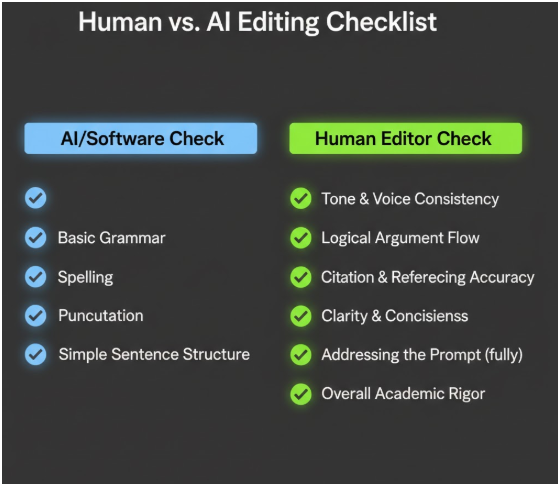
Quick Checklist Before Submitting:
- Run a Plagiarism Check: Even accidental plagiarism can have severe consequences.
- Check the Word Count: Ensure you are within the 10% margin of the requirement.
- Read It Out Loud: If you run out of breath reading a sentence, it’s too long. Break it in two.
- Verify the Prompt: Does your essay actually answer the question asked by the professor?
Final Thought
Navigating a 48-hour deadline is ultimately a test of your systems rather than just your speed. By breaking the process into distinct phases of research, drafting, and careful refinement, you can produce a submission that reflects deep thought rather than last-minute panic. The key is to remain disciplined with your time and ensure that the final version is polished, cohesive, and ready for evaluation. With a clear strategy in place, you can conquer the pressure and deliver quality work every time.
About The Author
Hi, I’m Alexander Anderson. I’ve spent years navigating the complexities of academic life, and I know exactly how overwhelming the pressure of tight deadlines and high expectations can be. As a writer and strategist at MyAssignmentHelp, my goal is to simplify the writing process for students by sharing practical productivity hacks and structural insights.