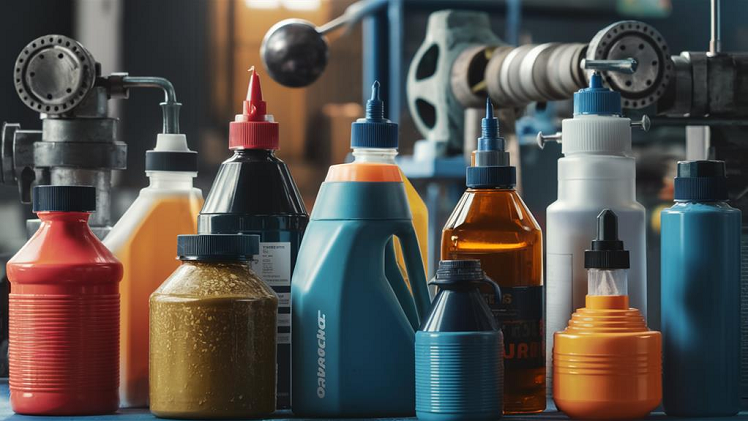
With there being a variety of lubrication products on the market, it is crucial for decision-makers at industrial sites to know what these solutions are, and the important distinctions between them.
The overriding principle of what lubricants do is, of course, fairly consistent irrespective of the specific product used. The lubrication process is about creating a protective film between moving surfaces, thereby preventing metal-to-metal contact and helping to lower friction and wear over time.
If, however, the wrong lubricant is chosen for a particular setting or task, this can lead to equipment breakdowns, heightened maintenance costs, and downtime that could have been avoided.
Let’s take a look, then, at the main types of lubricants available, the applications each one is best suited to, and the aspects you should be thinking about when attempting to select the most suitable product.
5 Main Types of Lubricants and Their Applications
- Oils (Liquid Lubricants)
If your given application requires continuous and flowing lubrication, the chances are that you will look to lubricating oils as a solution.
Oil-based lubricants are thin and free-flowing liquids that lend themselves well to high-speed applications necessitating low friction and good heat dissipation. Applying these lubrication products is easily done via drip, spray, or circulation systems. They can be trusted, too, to penetrate well into tight spaces.
Such a combination of qualities means oil-based lubricants tend to be frequently used on the likes of bearings, gears, hinges, chains, hydraulic systems, and compressors.
- Greases (Semi-Solid Lubricants)
You might find that in certain scenarios, lubricant leakage would be problematic, or maintenance intervals are longer. In cases like these, liquid lubricants might not make great sense.
Instead, then, you may look to greases or semi-solid lubricants. Grease is oil thickened with agents such as lithium, calcium, or polyurea soaps. This allows the substance to stay in place for extended spells of time.
You might be especially likely to make grease your chosen lubricant for a dusty, wet, or exposed environment, due to the enhanced sealing it can provide against contaminants. It is often used on such components as wheel bearings, ball joints, couplings, and open gears, and on high-load or vertical surfaces where liquid lubricants would drip away.
- Dry Lubricants
For all the benefits that oil-based and grease lubricants can bring, such conventional wet products can also attract grime. This is why, in certain situations, you might lean towards dry lubricants. These products leave a dry film that repels dust and dirt at the same time as providing low-friction lubrication.
Examples of dry lubricants include graphite and molybdenum disulphide offerings. You might use them on the likes of locks, hinges, sliding mechanisms, and conveyor guides. High-dust settings, or those where cleanliness is critical, are often a good match for dry lubricants like these.
- Penetrating Lubricants
When there are rusted or seized parts among your equipment that need to be loosened, it is typically a penetrating oil to which you will turn.
As the name implies, penetrating lubricants are formulated with the purpose of working their way into tight gaps, so that they can achieve such loosening. You’re therefore likely to use them on rusted bolts, hinges, or locks, or for automotive repairs.
- Specialist Lubricants
As this rundown has hopefully made clear, lubricant is never “just” lubricant! Indeed, certain industries require the use of lubrication products that have been created with specific operating conditions in mind.
Food processing equipment, for instance, typically needs to have food-grade lubricant applied to it. Meanwhile, for connectors and seals, it is necessary for electrical and silicone lubricants to be used. As for high-temperature lubricants, these products (as the term suggests) are effective when used in furnaces and ovens.
5 Factors to Consider When Deciding on A Lubricant
- Operating Temperature
Temperature can significantly impact on how lubricant performs.
In high-temperature conditions, products with excellent thermal stability need to be used. Low temperatures, meanwhile, require the use of lubricants that remain fluid and continue to circulate effectively.
- Load And Pressure
Heavy-duty applications place heightened pressure on lubricating films.
If machinery is operating under high loads, it will likely benefit from the use of extreme-pressure (EP) lubricants or specialised greases containing wear-resistant additives.
- Speed
Your ideal choice of lubricant will also probably be influenced by operating speed.
High-speed bearings, for instance, generally perform better when oils or lighter greases are used. As for slow-moving components that carry heavy loads, these often require thicker greases that can be counted on to stay in place.
- Environmental Conditions
You will also need to think carefully about the operating environment at your premises.
If components at your site are likely to come into contact with water, chemicals, dust, salt spray, or outdoor weather, you may need to look towards water-resistant, corrosion-resistant, or chemically stable lubricants.
- Material Compatibility
You can’t expect every single lubricant that you may consider to be compatible with every single material.
Petroleum-based products, for example, may have an adverse effect on certain plastics, elastomers, and rubber seals. Silicone lubricants, meanwhile, are often chosen where compatibility with non-metallic materials needs to be ensured.
Conclusion: Don’t Underestimate the Impact of The Right Lubricant Choice
Ultimately, when it comes to achieving the best possible reliability, streamlining costs, and improving safety, selecting the correct lubricant for your application can be a simple and highly effective way to accomplish these objectives.
For further advice and information on how to determine the most suitable lubrication solution for your given situation, you might be interested in consulting this article published by Plant & Works Engineering.