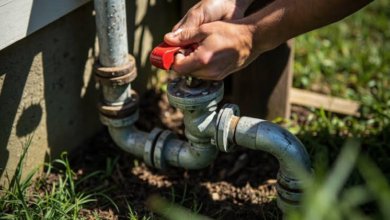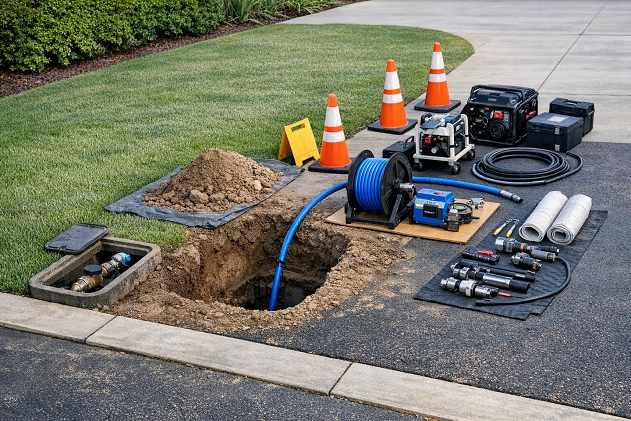
The order of operations decides whether your yard survives. Locate the buried line and camera it first, then dig only at the spot where the pipe actually failed. Do that backwards and a sixty-foot trench takes the silver maple’s root plate, the stamped patio and the driveway apron with it. For a homeowner on a mid-1990s quarter-acre lot in Lee’s Summit, the landscaping above the pipe is worth more than the pipe. So the smart search is not for the cheapest backhoe, it is for water line repair repair lees summit mo that starts with a diagnosis.
Soggy Lawn Patches Usually Point At The Service Line
A green stripe across a brown July lawn is the tell most people walk past. Job after job, the same thing turns up: one patch of turf that stays spongy while the rest of the yard bakes. Nothing drips inside the house, which is exactly why the leak runs a year before anybody calls.
Shut off every fixture and watch the flow indicator on the meter dial. Anything still creeping means water is leaving the pipe somewhere in that sixty-foot run. That is a plumbing call, not a landscaping one, because the next person through your gate decides the fate of everything growing above the pipe.
Buried Lines Fail By Material And Age
Material is the first question, and most homeowners cannot answer it. Copper, galvanized steel, polybutylene, PVC, lead on the oldest housing stock: each one ages on its own schedule. Utilities have tracked that on their own pipe for decades, and the pattern is not subtle.
Read those bars for what they are. They cover utility-owned mains under the street, not the private line running to your front wall. The numbers come out of a survey of utility systems rather than of houses, and the lesson still travels down the driveway. Old cast iron fails many times more often than modern PVC because material and age drive failure, not luck.
Age decides what is in the water too, not just whether the pipe holds. In November 2025 the Environmental Protection Agency cut its national estimate of buried lead service lines to about 4 million, less than half the 9 million it had estimated before. If your house went up in the mid-1990s, the material is rarely the villain and the failure is usually one joint or a rock riding against the pipe. If it predates 1970 and nobody has touched the line, prove out the material before anyone quotes you a trench.
Digging Blind Costs More Than Locating First
Call 811 before anyone touches dirt. Missouri’s One Call law is the reason, and the state Attorney General’s office spells out that notify-first duty for excavation in Missouri (the call costs nothing, and people still skip it). Locate crews paint the gas, electric, fiber and irrigation lines sharing that corridor, because a shovel finds all of them the same way. Utility strikes and trench collapses are how people get killed on jobs like this. The digging belongs to a licensed contractor, who traces the line, listens for the leak, runs a camera, then marks one spot. Blind trenching is the same repair at triple the damage.
What locating really buys is a smaller hole. A crew that knows the break sits eleven feet off the patio edge can sink one pit there and leave the maple alone. The root plate of a mature silver maple runs well past the drip line, and severing it does not read as damage for two or three seasons. Then the crown thins, the leaves come in small, and you learn what the trench actually cost.
Trenchless Methods Can Spare Patios And Driveways
Pipe bursting and directional boring exist for exactly this problem. Rather than an open trench from the meter pit to the house, the crew works out of two small pits and pulls new pipe along the old path. The stamped concrete and the driveway apron stay exactly where they are. Whether the method fits depends on soil, depth and the condition of the old line, and that call belongs to the plumber standing in your yard.
A backhoe has no opinion about your patio. Ask to see the camera footage and the locate marks before you sign anything, then ask what it would take to skip the open trench. If the honest answer is that trenchless will not work here, make them give you the reason in plain language.
What The First Week And Third Month Look Like
The first week is diagnosis and scheduling: locate, camera, 811 marks, then a quote naming a method and a spot. The dig itself usually runs one day on a quarter-acre lot, sometimes two if the apron has to be cut and repoured. Within 90 days the backfill settles, and it settles unevenly.
In the first month the turf is patchy and the seams still show. By month three the settling has mostly finished and the lawn reports exactly where the machine sat. Soil shifts with moisture and temperature, and it shifts hardest in a freeze. One late-January cold snap produced more than a dozen water main breaks across New York and New Jersey inside 7 days, which officials attributed to soil freezing around the buried pipe. A trench backfilled loose in November will telegraph every freeze-thaw cycle as a sunken scar across the front yard. Compaction deserves as much of your attention as the pipe.
Fix The Line Once And Keep The Yard
The pipe is the cheap part of this. What you are protecting is thirty years of maple canopy and a patio that costs more to replace than the repair does. Anyone comparing bids for water line repair repair lees summit mo should ask one question: does this crew locate and camera the run first, or just price a trench? The outfits worth hiring already have the footage, and they will walk you to the one spot where the work belongs.