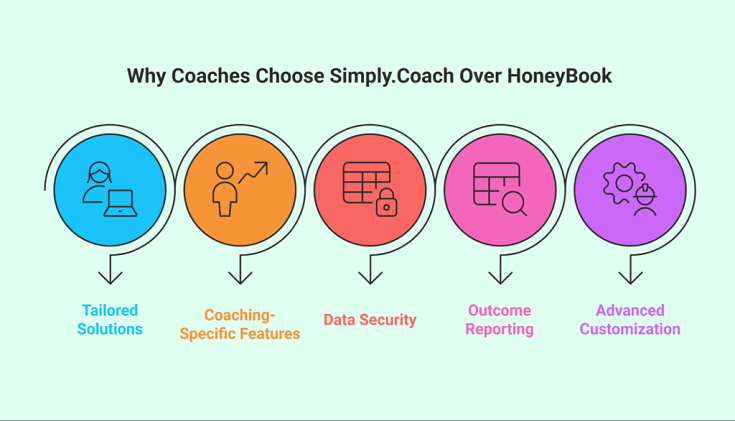
For many coaches, the software decision stops being a software decision very quickly. It becomes a question of how the business runs, how clients move through the experience, and how much of the real coaching process the platform can actually support. That is why honeybook vs simply.coach is not just a feature comparison. It is a comparison between two different product shapes.
HoneyBook presents itself as an all-in-one clientflow platform for service businesses, including coaches, with communication, scheduling, contracts, billing, forms, and notes. Simply.Coach presents itself as a coaching-centric platform and explicitly markets itself as a HoneyBook alternative for coaches.
If you are researching Honeybook alternatives, the real question is not which tool looks better on a pricing page. It is which one supports the parts of coaching you actually use every week? The ICF’s 2025 Code of Ethics still places confidentiality, agreements, accountability, and consistent client value at the centre of coaching work, which makes this a practical comparison, not a cosmetic one.
The Fastest Way To Understand the Difference
One platform is built first around the client flow. The other is built first around the coaching flow.
HoneyBook’s life coach software page leads with client communication, scheduling, online contracts, and billing from one central hub. Its health coach page adds questionnaires, intake forms, and templates. That makes it easy to read HoneyBook as a polished business-management platform that happens to serve coaches well. Simply.Coach’s comparison page, by contrast, frames the product around coaching-centric tools such as group or cohort coaching, editable coaching forms and surveys, and a coaching-first setup.
That distinction matters because many coaches do not only need to run a business. They need to run a process. Session by session, between-session, one-to-one, and sometimes in groups. So instead of asking which platform is “better” in the abstract, it is more useful to compare the core things coaches actually touch every week.
What Happens Before the Session
HoneyBook: Strong on intake, contracts, and billing
If your first priority is getting a prospect through enquiry, scheduling, contracts, and payment cleanly, HoneyBook makes a strong case. Its public pages for coaches and health coaches emphasise client communication, scheduling, online contracts, billing, questionnaires, intake forms, and templates. That is a serious advantage for coaches who want a polished front-end business system.
Simply.Coach: More focused on coaching setup from the start
Simply.Coach appears to approach the pre-session phase differently. Its HoneyBook alternative page and broader coaching comparison materials position the product less as a proposal-and-invoice engine and more as a coaching management environment. The emphasis is on coaching workflows, editable forms and surveys, and a setup designed specifically for coaches rather than for service businesses generally.
What that means in practice
If your early client journey is mostly commercial and administrative, HoneyBook looks especially comfortable there. If your early client journey is tightly tied to coaching structure, assessments, and programme logic, Simply.Coach appears more aligned with that use case.
What Happens During Ongoing Coaching
HoneyBook: Good for managing the relationship around the work
HoneyBook clearly supports ongoing client management in the business sense. Its site talks about notes, tasks, communication, and a central hub for projects, leads, clients, and payments. For many coaches, that may be enough, especially if the coaching itself is handled more manually by the coach rather than by the platform.
Simply.Coach: More explicit about coaching tools
Simply.Coach’s HoneyBook comparison page makes a different claim. It says HoneyBook does not offer coaching tools in the same way, while Simply.Coach supports coaching forms and surveys, group or cohort coaching, and a more coaching-centric structure. Because this is a vendor comparison page, it should be read as product positioning rather than neutral third-party judgement, but it does show very clearly how Simply.Coach wants to be understood: not as a generic clientflow platform, but as software built around coaching work itself.
What that means in practice
For a coach who mainly needs scheduling, invoices, templates, and client communication, HoneyBook may already cover the real workload. For a coach who wants the platform itself to carry more of the coaching process, Simply.Coach appears to lean further in that direction.
Group Coaching Is One of the Clearest Dividing Lines
This is where the comparison gets more concrete.
HoneyBook’s public coaching pages do not foreground group coaching as a core feature. They focus far more on clientflow, templates, communication, contracts, billing, and forms. Simply.Coach’s comparison page explicitly calls out group or cohort coaching as part of its offer and says that with HoneyBook there is no obvious group coaching feature in the same sense. Again, that claim comes from Simply.Coach’s own comparison page, so it is best read as stated positioning, but it does highlight a real product difference in how each tool markets itself to coaches.
If group programmes, cohorts, or shared coaching journeys are central to your business, this is probably one of the first areas to check in a live demo rather than relying only on surface feature lists. Based on public positioning alone, Simply.Coach is more eager to claim that territory.
Branding and Business Polish vs Coaching Specificity
HoneyBook feels naturally strong on polish
HoneyBook’s wider platform messaging is about bringing leads, clients, projects, and payments together in one place. It is clearly comfortable speaking to business owners who want a unified, elegant operations layer. That often shows up in areas such as proposals, online contracts, payments, templates, and clientflow.
Simply.Coach feels naturally strong on niche relevance
Simply.Coach’s public comparison pages keep pulling the conversation back to coaching-specific relevance. The product is framed less as an all-purpose small-business hub and more as software for coaches, mentors, therapists, counsellors, and consultants. That narrower focus can be valuable if you do not want to adapt a general system to a coaching business yourself.
What that means in practice
The choice here is not only feature depth. It is orientation. HoneyBook looks like a cleaner fit if you want a refined business platform that includes coaching. Simply.Coach looks like a cleaner fit if you want a platform whose identity is coaching first.
The Quiet Issue That Matters More Than People Admit: Confidentiality
Coaches are not only moving appointments and payments around. They are also handling client conversations, personal context, and sometimes highly sensitive reflections. The ICF’s 2025 Code of Ethics treats confidentiality and legal compliance as a dedicated section of the Code and emphasises transparency and accountability in coaching relationships.
That matters in this comparison because it changes how “core features” should be judged. A note tool is not just a note tool. A client portal is not just a convenience feature. A communication system is not just a messaging shortcut. These things sit inside an ethical relationship. So whichever platform a coach chooses, the better question is not only “Can it do this?” but also “Can it support the way I am expected to work professionally?”
Which Coaches Will Usually Prefer HoneyBook
HoneyBook looks strongest for coaches who:
- Want a polished clientflow and business-management system.
- Care deeply about contracts, payments, intake forms, templates, and communication.
- Run a relatively straightforward one-to-one business model.
- Prefer a broader service-business platform over a niche coaching product.
This does not make HoneyBook “less for coaches.” It simply means its public strengths are easier to recognise on the business side of coaching than on the coaching-method side.
Which Coaches Will Usually Prefer Simply.Coach
Simply.Coach looks strongest for coaches who:
- Want software that positions itself directly around coaching.
- Need group or cohort coaching support to be part of the product story.
- Want editable coaching forms and surveys framed as coaching tools.
- Prefer a platform that openly presents itself as a HoneyBook alternative for coaches.
In other words, if HoneyBook feels like a strong business platform that you might adapt to coaching, Simply.Coach is trying to be the platform that does not need as much adaptation in the first place.
The Smarter Buying Question
This comparison becomes easier once you stop asking which platform has “more” and start asking which platform is doing the kind of work your practice actually needs.
If the core of your weekly reality is:
- Booking
- Contracts
- Billing
- Intake
- Client communication
then HoneyBook may feel like a very natural fit.
If the core of your weekly reality is:
- Coaching workflows
- Group coaching
- Coaching-specific forms
- A platform built around coaching delivery
then Simply.Coach is likely to feel more directly relevant.
That is the real answer to the HoneyBook vs Simply.Coach question. Not which one is universally better, but which one is built closer to the coaching business you are actually running.
Final Take
HoneyBook and Simply.Coach are competitors for coaches, but they are not identical products wearing different branding. HoneyBook publicly leads with clientflow, contracts, billing, forms, and scheduling. Simply.Coach publicly leads with coaching-centric positioning, group coaching, and coaching-specific tools. That difference matters because coaches do not all need the same platform shape.
So if you are evaluating honeybook alternatives, the best next move is not just to compare price or the number of bullets on a features page. It is to compare what each tool assumes coaching actually is: a service business with sessions, or a coaching process with its own operational needs. HoneyBook and Simply.Coach answer that question differently, and that is exactly why this comparison matters.
FAQs
Is HoneyBook built specifically for coaches?
HoneyBook has coach-specific pages and clearly serves coaches, but its public positioning is broader than coaching. It presents itself as a clientflow or client relationship platform for service businesses, with scheduling, communication, contracts, billing, forms, and notes.
Is Simply.Coach a direct HoneyBook competitor?
Yes. Simply.Coach explicitly markets itself as a HoneyBook alternative and positions itself as a coaching-centric platform.
Which platform looks better for contracts and billing?
Based on its official pages, HoneyBook more clearly foregrounds contracts, billing, intake, templates, and clientflow as core strengths.
Which platform looks better for group coaching?
Based on public product positioning, Simply.Coach is more explicit about group or cohort coaching support. HoneyBook’s public coaching pages do not foreground that in the same way.
Why does confidentiality matter in this comparison?
Because coaching software often touches client information, notes, forms, and communication. The ICF’s 2025 Code of Ethics continues to treat confidentiality and legal compliance as core professional responsibilities.