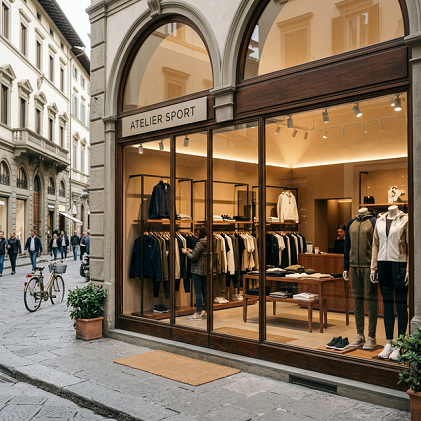
Walk into a well-curated independent fashion boutique in Warsaw, Athens, or Bucharest, and you might assume the carefully selected rack of branded sportswear and contemporary fashion was assembled through an intricate web of distributor relationships built over decades. In some cases, you’d be right. In a growing number of others, you’d be significantly wrong.
The supply chain feeding Europe’s most compelling independent retail stores has changed materially over the past four years. Understanding how – and why – reveals something important about both the fashion industry’s structural challenges and the opportunities they create for agile independent operators.
Where Boutique Inventory Actually Comes From
The standard retail narrative posits a clean, linear supply chain: brand produces, distributor stocks, retailer orders, consumer buys. This model still exists and still works for some categories and some retailers. But it describes an increasingly small fraction of how contemporary independent boutiques actually stock their floors.
The reality is multi-layered. Most independent retailers combine several sourcing streams: direct brand relationships where they can secure them, domestic distributor accounts, trade fair purchasing, and – with growing frequency – private B2B wholesale platforms that give them access to verified excess inventory from a wide range of brands and distributors.
This last category has grown from a supplementary sourcing option to a strategically central one for many operators, driven by two simultaneous forces: increasing difficulty accessing official brand distribution as major labels tighten their authorized retailer networks, and expanding availability of high-quality off-price B2B inventory as brands face persistent overstock pressure.
The Overstock Phenomenon and What It Means for Buyers
The fashion industry consistently overproduces. Production forecasting models regularly overshoot actual consumer demand, leaving brands and distributors with significant surplus stock – authenticated, current or near-current season, tagged at full retail – that needs to move outside primary channels.
This inventory enters the B2B secondary market in predictable, recurring volumes. For buyers, the products are identical to what would be purchased through official distributor channels. The difference is timing (end-of-season or mid-season clearance rather than forward order), pricing (typically 40-70% below retail depending on category and timeliness), and access mechanism (private platform versus distributor account).
The volume of available surplus stock from premium brands is larger than most independent retailers assume. Sportswear categories – including Adidas wholesale stock, athletic footwear, performance apparel, and branded lifestyle lines from comparable labels – represent a particularly consistent supply because production volumes are high and demand patterns are harder to predict precisely across diverse European markets.
What Private B2B Platforms Have Changed
The structural innovation in this space over the past several years has been the emergence of private B2B wholesale platforms that consolidate this surplus inventory under one verified, curated marketplace.
Before these platforms existed, accessing off-price branded inventory required personal relationships, trade fair attendance, or working through intermediary traders who extracted their own margin. The process was relationship-dependent, geographically constrained, and offered little transparency on what was available or at what price.
Private B2B platforms solve most of these problems simultaneously. Suppliers – brands, distributors, large retailers with surplus stock – list inventory directly. Verified B2B buyers – boutiques, multi-brand stores, resellers – access it in real time and can transact without needing pre-existing supplier relationships.
The verification layer on both sides is critical. Platforms that require business credentials from both suppliers and buyers create a protected environment: suppliers know their product reaches legitimate trade buyers, buyers know product is authentic and chain-of-custody documented.
The Boutique Operator’s Perspective
For the boutique owner or buying manager, private B2B platforms offer several concrete advantages over traditional sourcing:
Reduced capital commitment. Traditional distributor relationships often require seasonal pre-orders with payment due at or before delivery – capital committed six months before any sales data confirms the bet. Off-price platform purchasing operates on a much shorter cycle: buy stock that’s available now, at a known price, with delivery within days or weeks.
Lower effective cost basis. Buying at 20-30% of retail rather than 45-50% of retail creates margin headroom that makes the business significantly more resilient to the sell-through variability that characterizes independent retail.
Broader brand access. Many independent retailers can access brands through off-price platforms that they cannot access through official distributor channels due to minimum order requirements, exclusivity constraints, or distributor network restrictions.
Confidential sourcing. Well-designed private platforms ensure that buyers and suppliers never see each other’s identities, and that no competitor can monitor what’s being purchased from where. This protects the boutique’s competitive sourcing intelligence in local markets where multiple stores may serve overlapping customer bases.
The Geography Factor
One aspect of European boutique sourcing that’s often underappreciated is the geographic diversity of where off-price branded inventory originates. A distributor with a surplus position in Germany may have no domestic buyer capable of absorbing the volume – but boutiques in Greece, Poland, Romania, or Croatia can take that stock efficiently through a pan-European B2B platform.
This geographic arbitrage – matching surplus inventory in one market with buyer demand in another – is one of the primary value-creation mechanisms of private B2B wholesale platforms operating at European scale. For boutique operators in Central and Eastern Europe in particular, access to inventory originally destined for Western European markets often represents better brand representation than they could achieve through domestic channels alone.
The supply chain behind Europe’s best independent fashion boutiques is increasingly sophisticated, diversified, and platform-mediated. Retailers who understand the structural sources of off-price branded inventory – and access them systematically – are building businesses with structural margin advantages that traditional sourcing approaches simply cannot match.