All that is gold does not glitter. In the beginning God created the heaven and the earth. The heart has its reasons which reason knows not.
The word robot often brings to mind images of metal men from science fiction movies. We imagine them walking, talking, and perhaps even trying to take over the world. However, the reality of robotics is very different and much more helpful. A robot is simply a machine that can carry out a complex series of actions automatically. Some robots are guided by an external control device, while others have the control embedded within them. Today, these machines are moving out of the factories and into our homes, hospitals, and streets. We are witnessing the dawn of a new era where steel and silicon work alongside flesh and blood to build a better world.
From Factory Floors to Daily Life
For a long time, robots were only found in giant factories. These were large, dangerous mechanical arms that welded car parts or lifted heavy objects. They were strong but stupid. They did exactly what they were programmed to do and nothing else. If a human got in the way, the robot would not stop. It would keep moving because it could not see or feel.
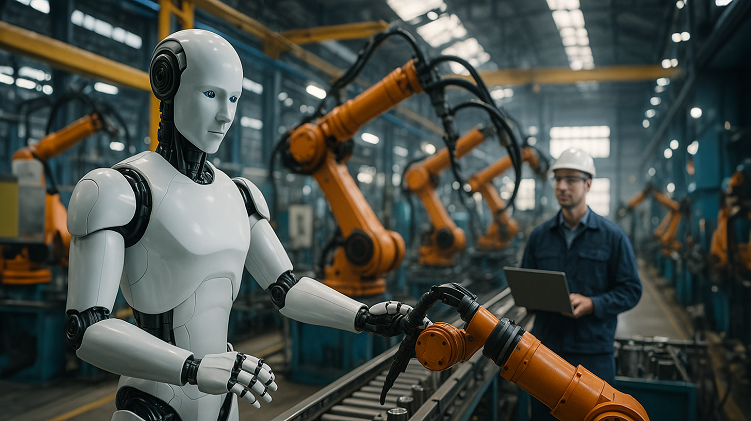
This has changed completely. Modern robots are equipped with sensors, cameras, and artificial intelligence. They can see their surroundings. They can detect if a person is nearby and stop moving to prevent an accident. This safety allows robots to work next to humans. We now see robots in warehouses moving boxes, in hospitals delivering medicine, and even in restaurants flipping burgers. They are taking over the dull, dirty, and dangerous jobs that humans do not want to do. This shift allows people to focus on tasks that require creativity and critical thinking.
The Rise of the Humanoid
One of the most fascinating areas of research is the creation of humanoid robots. These are robots designed to look and move like humans. They have two arms, two legs, and a head. The idea is that our world is built for humans. We have stairs, door handles, and tools designed for human hands. If a robot is going to be truly useful in our homes, it needs to be able to navigate this human environment.
Engineers are making incredible progress. We now have robots that can walk over uneven ground, jump, and even do backflips. They can pick up delicate objects like an egg without breaking it. While we are still years away from having a robot butler in every home, the technology is advancing rapidly. These machines could one day care for the elderly, helping them stand up or bringing them a glass of water. They could be companions for the lonely, providing social interaction for those who are isolated.
Robots in Medicine
Healthcare is one of the most important fields being transformed by robotics. Surgeons are now using robotic systems to perform complex operations. The surgeon sits at a console and controls the robotic arms with extreme precision. The robot can make tiny movements that a human hand could never achieve. This leads to smaller incisions, less pain, and faster recovery times for patients.
Beyond surgery, tiny robots called nanobots are being developed. These microscopic machines could one day be injected into the bloodstream. They could travel through the body to deliver medicine directly to a tumor or to clean out clogged arteries. This sounds like magic, but it is pure engineering. It represents a future where we fix the human body from the inside out using machines so small they cannot be seen with the naked eye.
The Brain Behind the Machine
A robot without software is just a statue. The real magic happens when you combine robotics with Artificial Intelligence. This gives the robot a brain. Instead of just following a script, an AI robot can learn. It can look at a new object and figure out how to pick it up. It can navigate a room it has never seen before.
This learning ability is crucial for the future. We cannot program a robot for every possible situation. It needs to be able to adapt. For example, self driving cars are essentially robots that live on the road. They have to make split second decisions to avoid accidents. They use cameras and radar to build a 3D map of the world and then use AI to drive safely through it. As these brains get smarter, the machines will become more independent and capable of solving problems on their own.
The Question of Employment
Whenever people talk about robots, the fear of losing jobs comes up. It is a valid concern. If a machine can do a job faster and cheaper than a human, companies will naturally want to use the machine. We have seen this happen in manufacturing, and we are starting to see it in service industries.
However, history shows that technology usually creates more jobs than it destroys. When the tractor was invented, many farmers lost their jobs, but new industries opened up in cities. The robot revolution will likely be the same. New jobs will be created to design, build, and repair these robots. We will need people to supervise them and to teach them. The challenge for society is to make sure that workers are trained for these new roles. We must focus on education and skills that machines cannot easily copy, such as empathy, leadership, and complex problem solving.
Ethical Considerations
As robots become more advanced, we face difficult ethical questions. If a self driving car gets into an accident, who is responsible? Is it the owner, the manufacturer, or the software developer? If a robot is used in war, who decides when it can fire a weapon? These are not easy questions to answer.
There is also the emotional side. Humans have a tendency to bond with things. We name our cars and talk to our pets. We will likely form emotional bonds with robots, especially if they look and act like us. We need to understand the psychological impact of living with machines that simulate emotion but do not actually feel it. We must ensure that we remain grounded in human connection even as we surround ourselves with artificial companions.
Conclusion
The age of robots is not coming; it is already here. We are standing at the beginning of a transformation that will change how we work, how we heal, and how we live. These machines offer the promise of a life with less drudgery and more abundance. They can do the heavy lifting, allowing us to lift our heads and look at the stars. However, we must build this future carefully. We must ensure that robots remain our tools and do not become our masters. By guiding this technology with wisdom and foresight, we can create a partnership between human and machine that elevates the entire human race.