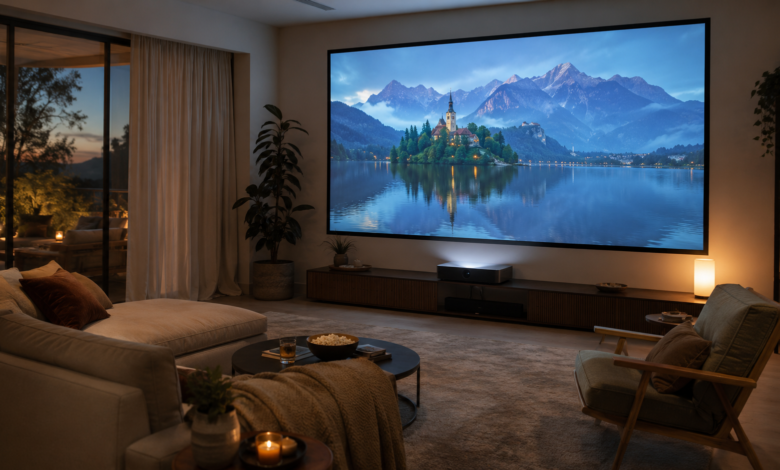
A living room has to do more than one job. It hosts conversations, quiet afternoons, family games, and the occasional movie night. That is why a successful home cinema is rarely the room with the most equipment. It is the room where the screen, seating, sound, and lighting fit ordinary life so well that watching a film never feels like a major production.
The best place to begin is not a product list but a map of how the room is actually used. Notice where people walk, where daylight enters, which seats are occupied most often, and which furniture cannot move. Those observations turn an ambitious entertainment upgrade into a practical design project.
Give the screen a calm visual home
A large picture needs a wall that does not compete for attention. Artwork, open shelving, glossy finishes, and bright lamps near the image can all make a scene feel less focused. You do not have to empty the wall completely, but it helps to create a clear visual zone around the screen. Low storage and restrained decor usually work better than tall cabinets that crowd the image.
In a compact room, an ultra short throw projector can support that cleaner arrangement because the equipment sits close to the display wall instead of occupying the middle of the room. The important planning question is still physical: measure the cabinet depth, screen position, and the space needed for ventilation before deciding where anything belongs.
Use painter’s tape to mark the expected image on the wall for a few days. Sit in every regular seat and look at the upper corners as well as the center. If viewers must raise their chins, the picture is probably too high. A slightly lower image often feels more relaxed and keeps the room visually connected to the furniture around it.
Plan seating for conversation and viewing
Rows of theater seats can look impressive, yet they may make a social room less useful. A sofa facing the screen, paired with one or two movable chairs, preserves a natural conversation area. When the chairs turn toward the picture for movie night, everyone gains a good view without permanently arranging the room like an auditorium.
Distance matters, but there is no universal number that suits every person. Image size, resolution, eyesight, and viewing habits all affect comfort. Test more than one seating position with familiar content. Subtitles are especially useful during a trial because they reveal whether the picture feels comfortably readable or needlessly overwhelming.
Control light in layers, not with one switch
Good cinema lighting is flexible. During the day, curtains or shades reduce glare without forcing the room into darkness. In the evening, floor lamps and wall lights can provide a soft background glow. Fixtures positioned behind or beside viewers are usually less distracting than a lamp reflected directly in the screen area.
A thoughtful living room home theater also needs a practical route back to everyday brightness. Put frequently used lights on easy controls, and keep a small task light near the seating for snacks, remote controls, or reading. The goal is not permanent darkness; it is the ability to change the mood in seconds.
Room color contributes as well. Pale walls bounce more light, while deeper matte tones close to the screen can improve perceived contrast. If repainting the whole room is unrealistic, consider a darker feature wall, lined curtains, or a broad matte surface behind the screen. Small changes near the image often have more impact than dramatic changes at the back of the room.
Make sound clear before making it loud
Hard floors, bare windows, and large empty walls create reflections that blur dialogue. Rugs, curtains, upholstered seating, and bookshelves introduce useful absorption and diffusion without making the room look like a studio. Start with these normal furnishings before considering specialized acoustic treatment. Clear speech at a moderate volume is a better sign of success than impressive volume alone.
Speaker placement should respect both the screen and the pathways through the room. Keep front channels aligned with the picture as closely as the layout allows, and avoid hiding speakers deep inside closed cabinets. If cables cross a walking route, use wall channels, baseboard runs, or professionally installed in-wall wiring rather than relying on loose cords.
Design the routine as carefully as the room
A cinema that requires several remotes and a sequence nobody remembers will be used less often. Label inputs, simplify startup steps, and keep essential controls in one place. Test the setup with someone who did not install it. If that person can start a movie, adjust the volume, and return to regular television without instructions, the system is ready for daily life.
Finally, leave room for change. Furniture moves, streaming devices are replaced, and families develop new habits. Accessible power, a little spare cable length, and modular storage make future adjustments easier. A cinema-ready living room succeeds when the technology supports the room quietly—then steps forward only when it is time for the lights to dim.
Run a Real-Life Dress Rehearsal
Before calling the room finished, use it for a complete evening exactly as the household normally would. Start with the lights on, choose a program, serve snacks, pause for a break, and return the room to its daytime arrangement. Notice whether anyone blocks the image, searches for a control, or avoids a seat because the view feels awkward.
This rehearsal also reveals small comfort issues that specifications cannot predict. A lamp may reflect only from one chair, the cabinet may make a faint vibration during bass-heavy scenes, or the room may become too warm after several hours. Correcting these details while the layout is still flexible is far easier than accepting them as permanent quirks. A polished home cinema is usually the result of several modest refinements, not one flawless installation day.
Keep a short note of the final measurements, cable routes, and preferred settings. That modest record saves time after a power interruption, furniture move, or equipment update, and it lets another person maintain the room without reverse-engineering every decision.