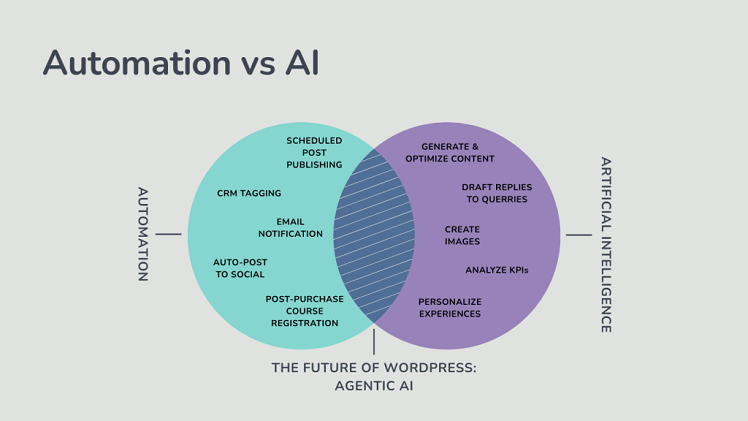
Choosing between AI and automation is quite a challenge for any company. Most people confuse them as the same thing, but actually, they function in very different ways. Deciding on which one to get can really help you save time, money, and even avoid a lot of worries. This article aims to help you understand what to choose, when, and why, without resorting to technical jargon.
What is basic automation?
Automation can be compared to a robot that constantly refers to a checklist. You simply provide it with a set of instructions, and the robot will carry out those tasks precisely in the same way every time. It cannot think or make decisions independently. It simply executes orders that you have given.
This is a great option for tasks that are very dull, repetitive, and do not change at all. For instance, if you decide that an email shall be sent out every time a person completes a form on your website, that is an example of automation.
What is AI?
AI is quite a different thing. It does not just follow a strict set of rules. Instead, it learns from data. AI can analyse the patterns and make an assumption or come up with a decision on the basis of what it has seen before. Whereas automation is efficient at carrying out tasks, AI excels at thinking and predicting.
In case your work involves data that is constantly changing or requires you to make a decision, AI is probably the best option. It is capable of dealing with unstructured information and figuring out the right way forward without a human having to give it every single instruction.
When to use automation
If your task is quite predictable, basic automation is the right choice. If you can jot down the steps on a piece of paper and those steps will never change, you are dealing with a perfect candidate for automation.
- Moving data: Using automation is the right thing to do if you have to take information from one spreadsheet and put it into another.
- Sending alerts: Automation is the tool for the job if you want to get a notification after a file has been uploaded.
- Simple math: Automation remains the way to go if you are computing taxes or totals based on fixed figures.
A perfect example of this is mortgage process automation. In the mortgage business, there are tons of forms to be filled out. A lot of time is saved by using automation to transfer the customers’ name and address from the application form to the bank’s database. It not only decreases errors but also speeds up the buying process for the person getting the home.
When to use AI
AI can be really helpful when a task is too complicated or if it has a lot of “what if” situations. When it is difficult to just write down the rules or when you need to go through a lot of data in order to discover a hidden pattern, in that case AI is the best option to choose.
- Talking to customers: A simple bot that is based only on automation will just give fixed responses, but an AI bot can analyze the customer’s mood and answer in a more helpful, human-like manner.
- Scanning documents: AI is capable of understanding what a handwritten note or a blurry photo means.
- Predicting the future: If you want to guess what products will have the highest sales next month, AI can use the data from previous years to make a very good guess.
The main differences in AI vs automation
Talking about AI vs automation, the biggest distinction comes down to how they react to errors. Automation, when faced with a problem it does not recognize, generally just fails or throws an error. It is not capable of self-repair. AI, on the contrary, can frequently work out a solution to the problem by drawing parallels to similar situations it has been exposed to before.
Another aspect that differentiates them is the installation. Automation is generally very fast to install, as you only have to write the rules. AI needs a much longer time, as it has to be trained on a very large amount of data before it reaches a level of intelligence that can be of great use.
Using them in combination
The most successful businesses don’t just choose one among these two. They employ both. Perhaps you could engage automation to carry out the bulk of the work and subsequently leverage AI to deal with the difficult issues.
For instance, referring again to the mortgage processing automation scenario, you may resort to automation for collecting all customer bank statements and IDs. Next, AI could be your tool to examine these documents for any signs of fraudulent activity or to determine if the applicant poses a high risk of default. This synergy of the two tools ultimately creates a far more robust system than relying on a single tool.
Picking the one best suited for your business
In order to understand which one fits your needs, you can simply ask yourself a couple of main questions:
- Do I do this particular work the exact same way each time? Then it’s a task for automation.
- Does the job involve a person’s mind making decisions? If so, AI is the tool.
- Is data used in the task neat and structured? Great! Then automation will be your buddy.
- Is the data in use untidy and hard to predict? Okay, then AI is what you are after.
The financial aspect and the pace
Automation usually comes at a lower price point. It operates on a set of straightforward instructions and therefore doesn’t demand a hefty amount of processing power. Besides, it is extremely quick as well. As for AI, it can be quite pricey because it needs specialized software and extensive data storage capacity. On top of that, the return in terms of the ability of AI to tackle complicated problems often justifies the cost over time.
Why humanization matters
Machines are still humans’ tools, and their help is still for humans ultimately. AI and automation, however you use them, should really only be conceptualized as means of making your employees’ and customers’ lives easier. On the one hand, automation frees people from mundane tasks so they can concentrate on more significant things. On the other hand, AI brings to the table information that leads to better decision-making.
Conclusion
There is no victor in the AI vs. automation war. Both are simply two of the many tools that quite literally sit in your toolbox. Automation is your hammer, very trustworthy and perfect for one specific task. AI is your multi-tool, a complicated one that can handle a wide range of different and changing situations.
For a start, spot those repetitive tasks that drain away your time. Automating those first is best. Once your company expands and your data gets complicated, also look at how AI can be instrumental in helping you get a grip on that data.